Lesson 006: Entanglement and Bell inequalities
Focus
Document classical post-processing: it often dominates wall-clock and interpretability. Token Entanglement and Bell inequalities|6 keeps neighbouring lessons differentiable.
Key ideas
- Thread: Entanglement and Bell inequalities · drill v6 · spin
537075. - Habit: pair each job with shot budget, mitigation profile, and a calibration fingerprint you could paste.
- Guardrail: write one line about where classical cost dominated the timeline.
Deep dive notebook
Merged catalogue entry (canonical Quanta GenAI Quantum AI lesson, relocated into tiered tracks).
Overview
Why this matters now
Nonlocal correlations without faster-than-light signaling. Teams rarely fail because nobody read a paper—they fail because interfaces between data, models, and humans are underspecified. Use this page as a working document: paste links to your runbooks, ticket templates, and evaluation dashboards (as plain text descriptions if URLs are internal).
Stakeholder translation: If you must explain the same idea to leadership and engineers, prepare two paragraphs: one with outcomes and risk, one with system components and dependencies.
Learning outcomes (detailed)
- Local hidden variable theories obey Bell bounds; quantum violates them experimentally.
- No-signaling holds: marginal outcomes remain under local control.
- Entanglement is a resource for protocols—not reducible to shared classical randomness alone.
Deep dive: hardware reality vs textbook circuits
Textbook diagrams assume perfect gates and arbitrary connectivity. On Northwind Analytics’s roadmap sessions, the limiting factor was often layout: swapping logical qubits to match connectivity adds depth, and depth burns coherence. Before debating algorithm families, estimate whether your bottleneck is shots (statistical error), coherence (circuit too deep), or calibration drift (time-of-day effects on some platforms).
Another under-discussed topic is classical post-processing: many algorithms hide expensive classical steps after measurement. For Silverpine University-style prototypes, teams succeeded when they treated the quantum device as one accelerator in a larger pipeline—logging classical optimizer iterations alongside quantum job IDs so failures were reproducible.
Nonlocal correlations without faster-than-light signaling. If you run simulators, note the qubit count where brute-force state vector simulation becomes painful; that informs honest claims about “quantum advantage” in your context.
Real-world scenario
Setting: You are a curriculum director at Riverbend Health. Nonlocal correlations without faster-than-light signaling.
Tension: Leadership wants a public demo in six weeks. Meanwhile, latency complaints from a pilot team, and customer success managers need a clear story—not only a model accuracy number.
What good looks like: Decisions are documented (what shipped, what was excluded), failures have owners, and the team can replay an incident with logs and prompts redacted appropriately. This lesson’s ideas apply even if your stack differs; translate nouns (vector DB, gateway, policy engine) to your internal services.
What would you measure first?
Pick one primary metric this week—not ten. Examples: P95 latency for first token, fraction of answers with a cited retrieval span, human escalation rate, or quantum job success rate vs queue depth. At Silverpine University, the team posted that metric in a shared dashboard with a threshold and a rollback plan when crossed. If you cannot graph it, you are not ready to argue you improved it.
Worked example (adapt freely)
Below is a template you can copy into your notes. Replace placeholders with your environment’s names so the example stays concrete.
# Pseudocode feel (pedagogical)
prepare |0..0>
apply U_problem
apply QFT_or_amplitude_amplification
measure -> classical_postprocess
# On hardware: respect basis gates, topology, and error mitigation settings.
Visual reference
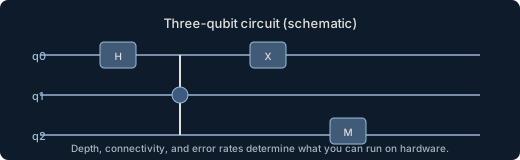
Circuit depth and connectivity interact with error rates on real hardware.
Pitfalls teams actually hit
| Pitfall | Safer habit |
|---|---|
| Assuming one metric tells the whole story | Report slices: region, language, risky intents. |
| Skipping failure drills | Run tabletop exercises for model + infra failures. |
| Unbounded prompts in logs | Redact and set retention; classify sensitive fields. |
Tradeoff lens
| Dimension | Favor left when… | Favor right when… |
|---|---|---|
| Prototype speed | Optimize for learning | Harden for repeatability |
| Model choice | Largest available | Right-sized + eval suite |
| Governance | Ad hoc review | Named owner + calendar |
Mini case study (fictional, composite)
Bluefield Energy ran a six-week pilot. Week 1–2 focused on instrumentation (latency, errors, human escalations). Week 3–4 tightened prompts and retrieval settings. Week 5–6 measured delta against the Week 1 baseline on the same tasks—avoiding “improvement” claims from a cherry-picked demo set. Their postmortem explicitly listed three refused or unsafe requests that surfaced, and how routing changed afterward. Copy that discipline: celebrate wins, but file the near-misses.
FAQ (short)
Q: Where should we start if we have only two weeks?
A: Pick one workflow, one metric, and one rollback story. Expand after you can demonstrate improvement on that slice.
Q: How do we avoid “slide-ware”?
A: Tie every recommendation to an observable: latency, cost, defect rate, or human review load—not generic “best practices.”
These answers are generic on purpose; replace them in your internal wiki with org-specific links.
Practice (from your catalog)
Explain in one paragraph why entanglement matters for quantum protocols.
Try the exercise twice: once quickly, once after sleeping on it—often the second pass surfaces edge cases.
Before you close this lesson
| Check | Done |
|---|---|
| Named the single workflow or concept this page helps | ☐ |
| Listed one metric you will watch for two weeks | ☐ |
| Identified who approves changes to prompts/policies | ☐ |
| Captured one “bad outcome” and how you’d detect it early | ☐ |
Closing
Keep this lesson inside Quanta GenAI: add screenshots (as new static assets if your admins allow), links to internal tickets, and names of partners. The goal is not perfection on first read—it is repeatable improvement with evidence.
Bundled reference content for Quanta GenAI Learn. Extend with your organization’s specifics.
Practice
Practice Simulate degraded calibration once; screenshot how you surface it to operators. — 6 Bump literals mindset by 13.